Last week I found out that Luis Miguel will be returning to the stage. The very first thing I did after learning about his big return was to navigate to his Spotify profile, play the This Is Luis Miguel playlist, and listen to the first song on the the set, “La Incondicional.” As soon as I heard the song, I became that young girl with black bangs, wearing a bright purple t-shirt with a matching floral set over it and white Keds, that sang along, while secretly wishing her school crush was listening and thinking of her.
I am really excited about Luis Miguel’s upcoming tour. Not because I am his biggest fan. There are other 1990s Latin pop artists that had a much greater influence on me growing up, Selena or Carlos Vives, for example. I am excited becuase upon listening to his music this time around, I found myself in an open dialogue with that young girl who sang along with him.
Mexican pop culture was my main source of television entertainment while growing up, making Luis Miguel a familiar face. Televisa, Mexico’s largest broadcaster in the 1990s, had an exclusive programming agreement with Univision, el cuarenta y uno, as my mom and grandma would refer to it. I remember him as a child actor co-starring in movies with Lucero and making stellar performances on weekend variety shows like Siempre en Domingo with Raúl Velasco. As his fame and popularity grew, so did the tasteless comments and critiques.
The critiques were never about his talent. I don’t remember people ever having anything bad to say about how he sounded or how he performed. The comments always revolved around his attitude; it was always over how arrogant he was. At the time, his looks confirmed the banter. A tall, handsome, green-eyed, white guy with a tan, with confidence confidence enough to showoff the wide gaps on each row of his teeth that, quite frankly would have any of us mortals running to the dentist. It was all the proof I needed to believe he was conceited—un creido.
The tight boundaries he maintained between his professional and personal life created a sore between him and his fans. We wanted it all. Entertainment and tabloid newspapers and magazines added to the injury. They were always trying to create speculation about his personal affairs: who he was dating, his children, his relationships with other artists, and of course his parents. But in my recent trip down the Luis MIguel rabbit hole, I realized he has been very generous with his fans. Perhaps he beat around the bush or gave unsatisfying answers, but he always answered and stood up for what he believed in.
The few times he agreed to interviews, they were always with prime time programs like Aquí y Ahora or television personalities with an established and respected careers like Myrka Dellanos or Gloria Calzada. And even then, he couldn’t escape the intrusive or probing questions that sought to overreach their boundaries.
Luis Miguel was interviewed in Chile by Álvaro Salas and Cecilia Bolocco for a primetime television program called Viva el Lunes. He was baited several times by Álvaro Salas, including a probing question that attempted to trigger him to talk about his conflicted relationship with maestro Armando Manzanero.
Luis Miguel is the oldest of three children born to Spanish singer-songwriter, Luisito Rey and Italian model, Marcela Basteri. I think there is something sinister about having an artist as a parent when you yourself have artistic talent. Just like with Selena and Michael Jackson, his father discovered his son’s artistic abilities early on and abandonded his own career to manage and represent him. He made him watch and study endless footage of Elvis Presley; his stage presence, his mannerisms, the way Elvis breathed while he sang. This effort wasn’t in vain, at age 14 Luis Miguel became one of the youngest people ever to win a Grammy.
He was exposed to the limelight at a very early age. And he learned, from his father I suppose, that some things are just nobody’s business. Luis Miguel was born in San Juan, Puerto Rico because Luisito Rey, was working on his music with some Puerto Rican producers when Marcela went into labor. He would have otherwise been born in either Italy or Spain. But this was one of those personal things that were better kept private.

It is no secret that Mexico is a launchpad for Spanish singing artists. For those seeking success in the Latin music industry, Mexico is a proving ground. It’s geographic position, economic power, and its very North American passion for consumption, makes it an important hub in the entertainment industry. And so, shortly after his first son’s birth Luisito decided to move to Veracruz in order to advance his artistic career. He failed. Miserably. His addiction problems and his swindling habits left him in an incredible amount of debt and without friends. But as his son grew older, he began to notice his potential and as a possible saving grace.
Where we are born is not up to us. I like to think about this accident as cosas del destino. There are people that make entire careers out of making us believe that our fate is marked by the position of the Sun, Moon, and other planets and stars, in relation to the time and place we were born. And this is exactly how Luisito decided to embark on his newfound career as his son’s talent manager. He forged a birth certificate claiming that Luis Miguel was born in Veracruz. He understood that by making Mexicans believe Luis Miguel was one of their own, it would make it much easier for him to break into the competitive Mexican music scene.
I wish the girl in the purple outfit had known that just like her, Luis Miguel would be tormented by people’s obsession to know where he was really from. Because of course, a quote-unquote Puerto Rican can’t possibly be the interpreter of the best version of “La Bikina” ever to be recorded. He would be an appropriator of a culture—a fake, a wannabe. But how do you explain to people that your place of birth doesn’t always translate to your talents or place of belonging?
The idea of knowing where others come from gives us an illusion that we can understand who they are. It makes us think we know what to expect from them. In some cases, especially when it comes to race, it can become an attempt to create a sense of safety: if we can place someone racially, culturally, or geographically, we convice ourselves that we know who they are. The entertainment industry is completely aware of our tribalistic nature. We are not. The moguls know that most people aren’t able to accept talent for what it is. There must be a story that tells us why we should accept them. Whitney Houston is the first person that comes to mind when I think about industry marketing tactics. She was able to cross over from the Gospel and R&B genres to mainstream pop culture because her public image was shaped to White beauty standards: thin, relaxed hair and pastel make-up.
And to be fair, I’ve also seen racial opportunism or racial ambiguity take place in the entertainment industry. Some artists move towards a racial or cultural identity if they know it can give them access to an audience or other benefits. But I’ll leave that for another essay.
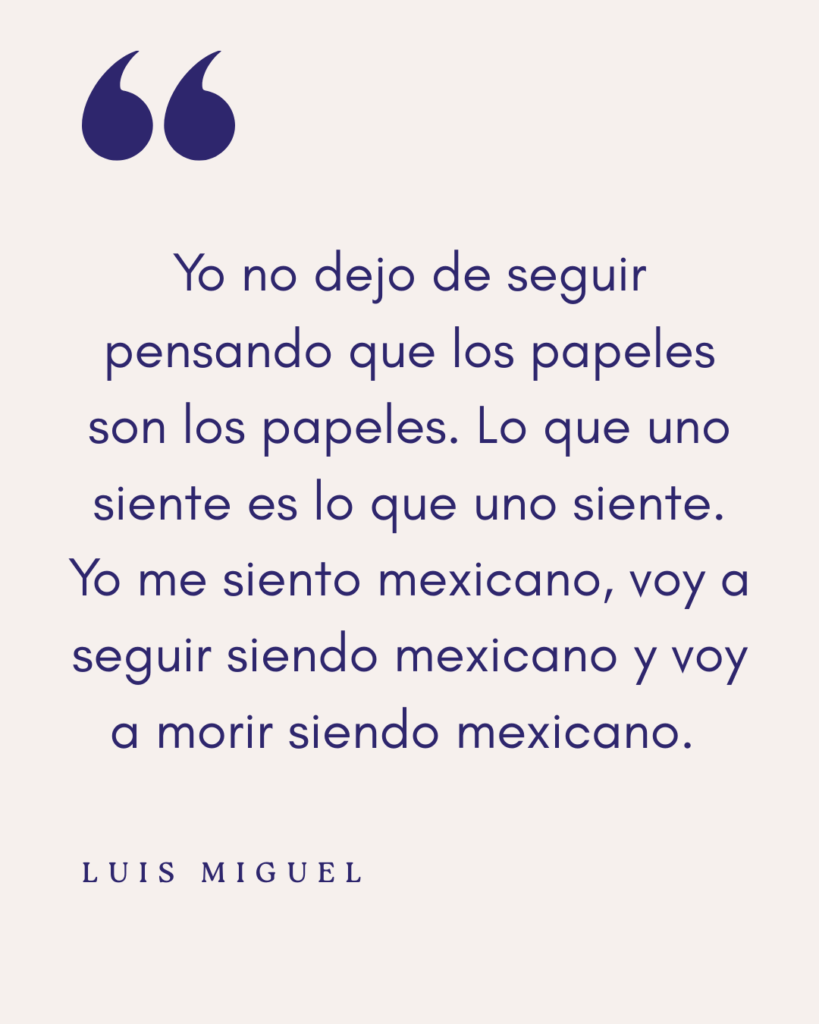
Rumors about Luis Miguel’s place of birth began to circulate around his fandom. His entire artistic credibility was on the line because someone had leaked a copy of his original birth certificate. El Sol de Mexico, as he became to be known, was at the verge of becoming a traitor (un falso), a forger (un delicuente), and an exploitor (un aprovechado) of Mexican culture.
Just like Mexican pop culture became the main source of entertainment for most Latino families in the United States, Mexican politics were also front and center stage. Carlos Salinas de Gortari is the first Mexican President I remember. His party, el PRI (Partido Revolucionario Institucional) governed Mexico for 71 years during which he served between 1988 and 1994. The party logo was displayed, and his name was mentioned daily on the evening television news programs I watched at home.
Carlos Salinas de Gortari. I always thought he had an unsual name. It didn’t sound like any of the last names of people I knew. I felt that way with a lot of the Presidents from the 1990s: Fujimori, Menem, Bush, Clinton. Actually, not much has changed. It still happens to be the case.
Luis Miguel was at the peak of his popularity during the Salinas de Gortari administration. He dominated the Latin music charts, his record sales were unbeatable, and girls in the United States and Latin America went crazy for him. The Fernandez family (Vicente, Pedro, and Alejandro), Christian Castro, Mijares, Timbiriche, and Gloria Trevi, just to name a few, were contemporary pop artists to Luis Miguel in the 1990s. But Luis Miguel was more than a pop star. He was the man of the era. He moved masses around Latin America and the governement was well aware of his influence.
The current state of music videos really pale in comparison to those of the 80s and 90s. They were massive because most of them told a story. Michael Jackson, of course, was the best to ever do it with videos like “Scream”, “Thriller”, and “Do You Remember the Time”. They were also a perfect way to get a message across. Think of Public Enemy’s “Fight the Power” music video protesting instutional racism and police brutality or Lee Greenwood’s “God Bless the USA”, which was basically a military campaign during the 1991 Gulf War.
El PRI’s governorship was plagued with repression, corruption, and a what seemed to be never ending electoral manipulation. Their government is marked by the Mexican Dirty War, a national conflict in which the government escalated the use of violent tactics to silence and repress their citizens. I have memories of news segments covering these acts. For some reason I can’t remember feeling the despair I feel when I watch similar coverage today.
By the time Salinas de Gortari’s assumed power in 1988, there was significant mistrust around the Mexican political system. Rebuilding people’s confidence in government was top of the order for his administration. The United States had already demonstrated the power of pop culture, with music and movies like Top Gun and Escape to Athena, to restore the public’s perception of the military following the disasterous Vietnamese War.
“La Incodicional” was the hit single of Luis Miguel’s sixth studio album, Busca una mujer. It is a romantic ballad about regret where the singer acknowledges that he took the woman’s “unconditional” love for granted. I must have been around six or seven years old when that song hit its popularity, and as the six or seven year old child I was, I had no business singing that song the way I did. The song served its purpose. It was an evocative primer in shaping the good girl I was supposed to become—unconditially always there.
The music video for “La Incondicional” was also a nudge toward what love and courage were supposed to look like. As we watched a young and handsome Luis Miguel enlist in the military to serve his country while the “love of his life” patiently waited for his return, we were shown what real character was all about. And it worked like a charm. A year after the video premier, Mexico had reported an all time record for voluntary military enlistment. And two years later, Luis Miguel would become a naturalized citizen of the United Mexican States.
I remember the Latin Explosion of the 1990s. What a time to be Latino. Two years prior to the start of the decade, Ronald Regan had officially declared September 15th the beginning of Hispanic Heritage Month. It was an expansion of Lyndon B. Johnson’s Public Law 90-498, which created the National Hispanic Heritage Week in 1968. Perhaps the US government realized the economic and political power that Hispanics held, and what better way to commemorate this than by dedicating a full month to the commercialization of our culture.
In this spirit, the 90s also brought us the Latin Grammys. An award ceremony that was created to celebrate Latin music and does everything but. During this time, many Latin artists had crossed over, which was the term that we use to describe when a non-English speaking artist successfully breaks into the Anglo-American mainstream market. We had several: Ricky Martin, Gloria Estefan, Jennifer Lopez, and Enrique Iglesias to name a few. Luis Miguel never made that list and he still became the king of the Billboard Latin Pop Album Charts. He had the most number one albums in the 1990s.
This was one of two things that solidified his image of being conceited or creido. He was adamant about singing in Spanish. When confronted by an American journalist about his choice not to cross over like others had done, he answered with pride, like a true Mexican would, “I like my language, I feel really proud of it. Other people are doing it. Why am I going to do it?” He didn’t need to change to earn acceptance from others, and this confidence is not always well recieved.
Luis Miguel also refused to attend award ceremonies. Although he was always a nominee, and often times a winner, he saw award shows for what they were: a popularity contest that had very little to do with what they were honoring, in his case, music.
Luis Miguel defined his own succes.
My love for music began with my mom. Music and sports have always been our thing. They are the two things that always brought us together no matter how upset we were at each other. She had a modest collection of vinyls that we would listen to on weekends. Most of it was tropical music: La Sonora Matancera, Lucho Bermudez, Joe Arroyo. She also had a few editions of los 14 Cañonazos from Discos Fuentes and of course El Binomio de Oro. I enjoyed all of it. But she had a few selections I really didn’t like; the alleged kings of bolero: Lucho Gatica, Roberto Ledesma, and Julio Jaramillo. She tried to sell it to me but was unsuccessful. The music felt distant, slow, cheesy, exaggerated, and annoying. Just looking at the vinyl sleeves would give me anxiety. It was usually the face of a smiling man in a bow tie, that I suppose was to be a heartthrob. It reminded me of the Ceshire Cat from Alice in Wonderland. I hated it.
One day, I can’t remember when or how exactly, I listened to Luis Miguel’s interpretation of “La Barca”. It must have been on one of those weekend variety shows. I was blown away. I loved the new Luis Miguel song and I showed it. I quickly learned from my mom it wasn’t a “new” song. It was a Lucho Gatica cover. I couldn’t believe it.
That seemed to be a recurring conversation with my mom. She had arrived to New York City in 1969. The trends from the 90s that were new to me, were not really new. It was all just a 70s repackage that she had already gone through: the flared jeans, the platform shoes, the bandanas and the tie-dye. It was a always a good time when the photo albums came out. It was like flipping through a fashion magazine where all the faces were familiar to me and they were all supermodels.
It wouldn’t be just one Lucho Gatica cover. Romances was Luis Miguel’s twelfth studio album, and what an album! It was realeased in 1997. They were all songs my mom already knew. We never got the vinyl because CDs had taken over but it closed that small gap that existed between what brought us together. It got us both singing, “Sabor a Mi”, “El Reloj”, “Besame Mucho”, and “La Gloria Eres Tú” and, I was discovering for the first time what my mother had always known.
Bendito seas, Luis Miguel.